








Why buy hookah charcoal from Egypt?
Most of the world's coconut shisha charcoal comes from Southeast Asia, but more importers in the Middle East and Europe now add an Egyptian supplier for three practical reasons:
- Location: Egypt sits on the Mediterranean, close to European, Gulf and North African ports, which usually means a shorter sea voyage than shipping from Asia.
- Port options: containers can leave from Damietta, Port Said or Alexandria on the Mediterranean, or from Ain Sokhna on the Red Sea for Gulf and East African routes.
- Easy visits: you can visit the factory, see production and packing yourself before your first order, and communicate in English or Arabic.
Country of origin alone does not guarantee quality. Compare suppliers by the numbers, as we explain in Egyptian vs Indonesian coconut charcoal.
Step 1: Check the import requirements in your country
Before contacting any supplier, ask a customs broker in your country about three things:
- HS code: coconut shell charcoal falls under heading 4402 (wood charcoal, including shell or nut charcoal). Since the HS 2022 edition it has its own subheading, 4402.20 "of shell or nut". National codes beyond six digits differ by country, so use the one your broker confirms.
- Duties and taxes: these depend on your country and its trade agreements with Egypt; the certificate of origin can affect the duty rate.
- Special requirements: some countries require an import licence, a registered business, or specific information printed on the pack in the local language. Find out early so it can be printed on the carton.
Step 2: Choose the right product for your market
A clear quote request starts with three choices:
- ShapeCube, hexagonal, finger, dome, cube with hole
- Cube size25, 26 or 27 mm
- GradePlatinum, Super Premium or Premium
The 25 and 26 mm cube is the most requested in most markets, but some markets prefer hexagonal or finger shapes. See our shape guide and size guide. The grade depends on what your customers expect and your selling price; the numbers are in coconut charcoal grades compared.
Also decide on packaging: 1 kg, 500 g or 250 g boxes inside 10 kg cartons, or loose packing in 10, 5 or 3 kg cartons, and whether you want it under your own brand. Details are on our packaging page.
Step 3: Verify quality before you commit
Do not rely on photos and promises. Ask for the specifications in writing (ash, moisture, fixed carbon, burn time and drop test) and test the product yourself if you can. Our guide to 6 simple hookah charcoal tests shows how to check any charcoal in minutes.
If possible, visit the factory. We are in New Damietta, next to Al-Azhar University, and welcome visitors Saturday to Thursday, 9 am to 6 pm. A visit shows you the raw material, production line, drying and packing, and is the fastest way to build trust before the first container. Before choosing a supplier, review 10 questions to ask any supplier.
Step 4: Request a quotation with the right details
The more precise your request, the faster and more accurate the quote. Include:
- Shape, size and grade.
- Quantity and container type (20 ft or 40 ft).
- Packaging type and pack weight, and whether it is private label.
- Shipping term (CIF or EXW) and destination port.
- Preferred payment method.
We do not publish prices on the website because they change with these factors and with raw material and freight costs. We reply to quote requests within 24 hours. To understand what moves the price, read what determines the price of coconut charcoal.
Step 5: Agree on shipping and payment terms
The shipping term decides who pays freight and insurance and when responsibility passes to you. We work on CIF to your destination port or EXW from the factory. The difference is explained in CIF vs EXW vs FOB.
Available payment methods are bank transfer (T/T), letter of credit (L/C), Western Union and MoneyGram. The payment method and schedule are written on the proforma invoice before production starts. Pros and cons of each are in our payment terms guide.
Step 6: Production and lead time
- Minimum order20 ft container (15 tons)
- 40 ft container27 tons
- Lead time15 – 35 days
Lead time starts once the order is confirmed, the agreed payment is received and, for private label, the pack design is approved. Larger orders and new designs take longer. Plan ahead of peak season in your market, such as Ramadan and summer. More in MOQ and lead time, and carton counts in container capacity.
Step 7: Shipping and documents
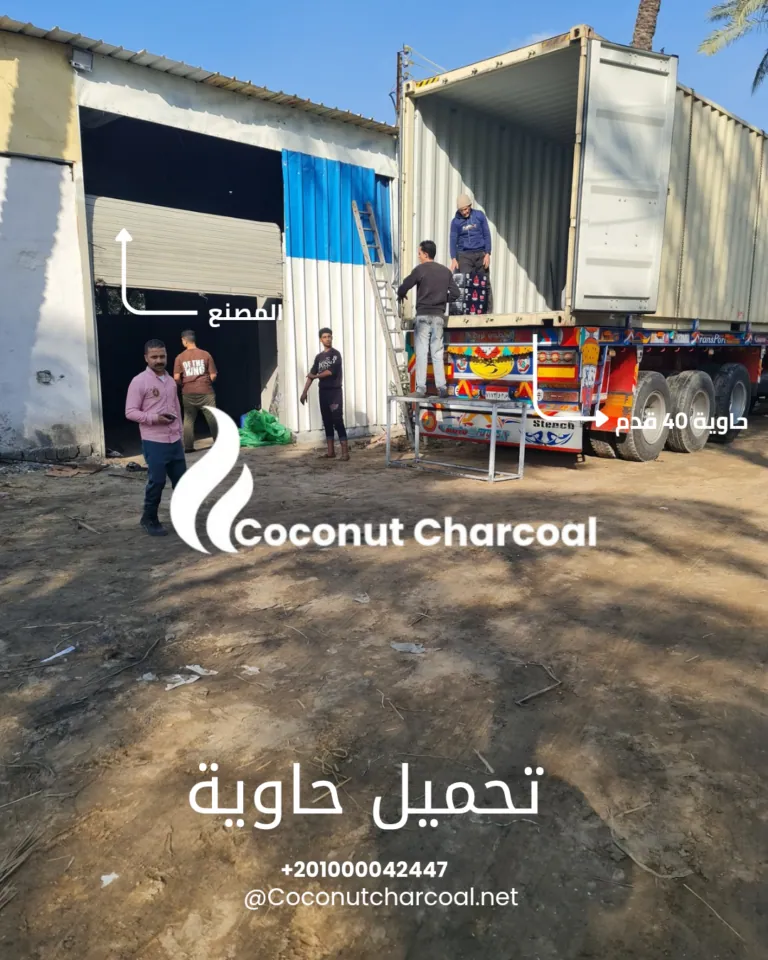
We ship from Damietta, Port Said, Alexandria and Ain Sokhna with most major shipping lines. Charcoal is a material that can self-heat, so carriers require specific documents before accepting the booking, most importantly a Safety Data Sheet (MSDS) and proof that the charcoal passed the self-heating test. Alongside these come the usual commercial documents: commercial invoice, packing list, bill of lading and certificate of origin.
Each document and why it is needed is explained in our coconut charcoal export documents guide. Check with your broker for any extra documents your country requires.
Step 8: Receiving and customs clearance
After the container sails, you receive the original documents or copies depending on the agreed payment method. Hand them to your customs broker well before the vessel arrives to avoid demurrage and storage charges. On arrival, inspect the cartons and photograph any damage immediately, then store the charcoal in a dry, well-ventilated place as explained in how to store hookah charcoal.
Quick checklist before your first order
- You know the HS code, duties and requirements in your country.
- You have chosen shape, size, grade and packaging.
- You have tested a sample or visited the factory.
- You have a proforma invoice stating specifications, quantity, price, shipping term, payment method and lead time.
- Your pack design is approved (for private label).
- You have a customs broker lined up at destination.
Frequently asked questions
Can I import less than a full container?
Our minimum order is one 20 ft container with 15 tons. A 40 ft container holds 27 tons.
How long does a hookah charcoal order take?
Production takes 15 to 35 days depending on quantity, starting after order confirmation and pack approval. Sea transit to your port comes on top of that.
Which Egyptian ports do you ship from?
Damietta, Port Said or Alexandria on the Mediterranean, or Ain Sokhna on the Red Sea, depending on the destination.
What is the HS code for coconut charcoal?
Heading 4402; under HS 2022 the subheading for shell or nut charcoal is 4402.20. National codes beyond six digits vary, so confirm with your broker.
Can you pack the charcoal under my brand?
Yes, we pack under the customer's brand on boxes and cartons. Send your design or ask the export team for the box dimensions.
Further reading: